Fiber Joint Closures
Fiber joint closures, also known as fiber optic splice closures, protect and
organize optical-fiber splices and cable joints in outside-plant networks.
They provide environmental sealing, mechanical protection, cable retention,
fiber routing, and splice-tray accommodation for aerial, duct,
direct-burial, and underground installations.
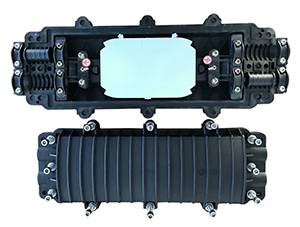
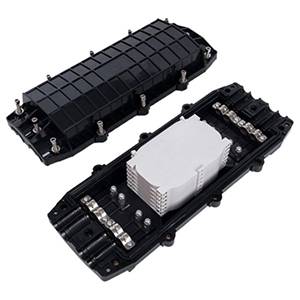
Horizontal In-line Splice Closure
This type of closure is designed for straight through splicing, where two or more optical cables enter and leave the enclosure from opposite ends in a linear arrangement. It is widely used for aerial overhead installations or direct burial applications, providing a low profile, streamlined enclosure that sits neatly along the cable run. Key options: • Core capacity, such as 12, 24, 48, 96, or 144 fibers. • Form factor, such as half-type, Big D, or standard in-line shape. • Port configuration, such as 2-in-2-out, 3-in-3-out, or 4-in-4-out, determining how many cables can enter and exit. • Material used, typically ABS plastic, PC+ABS alloy, or polymer plastic for durability. • Sealing method, such as heat shrink sealing or mechanical rubber gasket compression. • Installation type, such as aerial, lashed to a messenger wire, or underground, directly buried. • Locking mechanism, such as screw-lock bolts, snap-latches, or anti-removable screws for security. • Color, often black or gray to resist UV exposure outdoors.
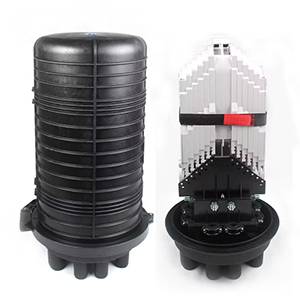
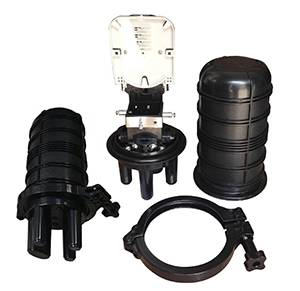
Vertical Dome Splice Closure
This type features a rounded, dome shaped enclosure that is mounted vertically on poles, walls, or in manholes. It is particularly suitable for branch splicing, where one main feeder cable is split into multiple distribution cables. The dome design offers excellent water drainage and ample internal space for multiple splice trays. Key options: • Core capacity, such as 12, 24, 48, 72, 96, or 144 fibers. • Inlet and outlet ports, such as 1-in-3-out, 1-in-4-out, 1-in-6-out, or 1-in-8-out, allowing flexible branching. • Material, typically high strength polymer plastic with UV resistant additives. • Sealing type, such as heat shrinkable barrels or mechanical compression seals with rubber O-rings. • Mounting type, such as pole mounting with steel straps or wall mounting with brackets. • Splice tray capacity, determining how many individual splice trays can be stacked inside. • Air valve, often included for pressure testing and leak detection. • Reusability, such as whether the closure can be reopened for future maintenance or is permanently sealed.
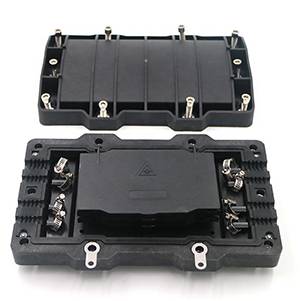
Mini Splice Closure (Small Repair Box)
This is a compact, lightweight closure designed for low core count splicing in tight spaces or for emergency cable repairs. It is often used to join drop cables directly in the field without requiring large, heavy enclosures. Its small footprint makes it ideal for confined manholes, wall corners, or direct aerial hanging. Key options: • Core capacity, typically 2, 4, 6, 8, or 12 fibers. • Port configuration, usually 1-in-1-out or 2-in-2-out for simple straight splicing. • Material, such as lightweight plastic, PP (polypropylene), or ABS. • Installation method, such as aerial hanging directly from the cable, wall mounted with screws, or double sided tape. • Splice tray capacity, such as one small tray holding a limited number of splices. • Sealing type, often compression rubber gaskets for easy reopening. • Color, often black or white, depending on whether it is used indoors or outdoors.
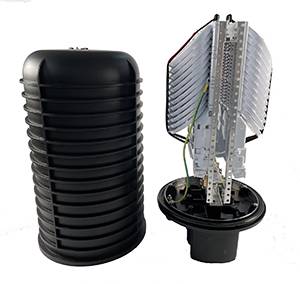
Waterproof Underground Closure (IP68)
This type is fully sealed against water and dust intrusion, specifically engineered for harsh underground environments such as direct burial trenches, handholes, and flooded manholes. These closures provide the highest level of environmental protection to ensure long term reliability in continuously wet or submerged conditions. Key options: • IP rating, almost always IP68, meaning it is dust-tight and capable of continuous immersion in water. • Core capacity, such as 24, 48, 96, or 144 fibers. • Port configuration, such as 2-in-2-out, 3-in-3-out, or uncut cable ports for passing through continuous cables. • Material, such as high strength engineering plastic or corrosion resistant steel with thick rubber sealing gaskets. • Installation type, such as direct burial, underground pit, or manhole placement. • Splice tray capacity, such as 4, 6, or 8 splice trays for organizing multiple splices. • Locking mechanism, such as heavy duty screw-locks, padlock hasps, or tamper-proof bolts. • Color, typically black, with no translucent parts to protect the fibers from light and algae growth.
High-Capacity Multifunction Closure (144, 288, 576 Cores)
This type is used at major network hub points, central offices, or large FTTH distribution nodes where extremely high fiber counts must be consolidated and spliced. These large enclosures offer multiple entry and exit points, ample splice tray capacity, and can also accommodate PLC splitters or wavelength division multiplexing components. Key options: • Core capacity, such as 144, 288, or even 576 fibers. • Port configuration, with multiple ports such as 4-in-4-out, 1-in-6-out, 1-in-8-out, or 2-in-24-out for complex distribution. • Form factor, which can be large horizontal in-line or oversized vertical dome. • Material, typically heavy duty polymer plastic or steel for structural strength. • Splice tray capacity, often accommodating 6 to 12 or more individual splice trays. • Splitter compatibility, such as built-in or modular splitter mounting positions for 1×16, 1×32, or larger ratios. • Sealing type, such as mechanical rubber seals for easy re-entry during network upgrades. • Color, usually black, and may include grounding brackets for metallic cable elements.
Aerial Pole-Mount Closure
• This type is specifically designed with mounting brackets or steel straps to be attached directly to overhead utility poles. It is widely used in FTTH networks to bring fiber from a pole-mounted feeder cable to multiple surrounding homes or buildings. The design emphasizes easy installation at height and resistance to wind, rain, and UV radiation. Key options: • Core capacity, such as 12, 24, 48, or 96 fibers. • Mounting type, such as pole mounted with stainless steel straps or pole mounting brackets. • Port configuration, such as 1-in-3-out, 1-in-4-out, or 2-in-2-out for branch distribution. • Material, such as UV resistant ABS or polymer plastic, sometimes with steel reinforcement. • IP rating, typically IP67 or IP68 to withstand rain, snow, and dust. • Splice tray capacity, with built-in trays to manage drop cable splices. • Color, almost exclusively black to resist UV degradation and blending with pole hardware. • Locking mechanism, often a screw-lock or hasp for securing against unauthorized access.
Note on Options:
Specify closure type, splice capacity, cable-port quantity and cable-diameter range, splice-tray configuration, sealing method, enclosure material, mounting method, and required environmental rating. Common configurations include dome/vertical and horizontal/in-line designs with mechanical, heat-shrink, or gel-sealing systems.
